Tampilkan postingan dengan label Reunion. Tampilkan semua postingan

Night visit to Bois Rouge sugar factory


One wet and windy evening recently I found myself on a night visit to the Bois Rouge sugar factory in Saint André, one of only two sugar factories that still operate on Reunion Island.


While the adjacent rum distillery can be visited all year round, the sugar factory can only be toured during the cane harvest season, which runs from June to December.


Bois Rouge receives sugar cane from the whole of the island's east coast, from Sainte Rose to Saint Denis.


As soon as the sugar cane is delivered, the loads are weighed and sampled by an independent technical centre to assess the sugar content.


Weight and richness in sugar are determining factors in fixing the sugar cane buying price.


The unloaded sugar cane then goes into a shredder, a machine composed of 144 hammers mounted on a shaft. The hammers pulverise the cane onto a huge anvil in order to ensure clear passage for the cane fibre into the other machines.


Once the sugar cane juice has been extracted, it is clarified and decanted by being preheated to 105°C, and lime is added to stabilise its pH at 7.5. During the decantation process a flocculant polymer is added to obtain clear juice.


The leftover filtration residues following decantation are known as filter cakes. These cakes are rich in phosphates and are given back to the cane planters who use them as fertiliser.


The clear juice is preheated to 120°C and enters a 6-effect evaporation station. Output steam from the power station is introduced into the first evaporator body. As it passes through the evaporators the clear juice is concentrated into a syrup known locally as Sirop La Cuite.


Next the syrup is crystallised in a cooking vacuum pan. The operators feed in a certain quantity of syrup and then add a few sugar grains in order to set off the crystallisation process. At the end of this process a crystallised mass is obtained, which is continuously mixed enabling the sugar contained in the original liquid to settle on the crystals and ensure greater crystal growth.


A centrifugal process separates the original liquid from the sugar crystals. In order to obtain high-quality crystals superheated water is used to dissolve the envelope of the original liquid surrounding the crystals. Finally, after the centrifugal process the original liquid undergoes two other crystallisation cycles in order to extract as much sucrose as possible.


At the end of the three successive crystallisation, mixing and centrifugation cycles, a liquid called molasses is obtained, which is low in sucrose content. Molasses are transferred to the distillery for rum and alcohol production.


one of the workers

in the control room


Since 1992 in addition to its basic manufacturing process, the Bois Rouge sugar plant has been developing consumer sugar units for brown and refined white sugar.


sugar sample for laboratory testing 

These high added-value products require specific manufacturing processes all the way through the different production stages.

some different types of sugar
- the finished product !


You might also enjoy:


Slacklining in Reunion Island

I've previously posted an incredible video about slacklining across the 3 Salazes, here are more videos of slacklining in Reunion, including a world record!

The first shows Swiss Raphael Bacot and his Reunionnese counterpart Kevin Borg of Slackline 974 crossing a suspended midline against a background of exploding waves on the south coast, at Cap Mechant.


© Dronecopters

© Dronecopters

The second takes place in the isolated mountain cirque of Mafate and shows Kevin crossing a 40-metre high gorge at Trois Roches. Both these exploits were filmed using a mixture of images from a Gopro (from the slack liners' point of view) and aerial shots by drones.


The third video shows Nathan Paulin setting a world record on 9th June 2015 by crossing the longest slackline in the world, 403m long and 250 metres above ground at the Cassé de la Rivière de l'Est. It took him 23 minutes to walk the 403m and he was filmed by Les six patates. (A few weeks later he set a new world record highline at the Natural Games in Millau, France – 469m).


See also:

Mauritius seen from Reunion and vice versa

Well-known local photographer Luc Perrot published a photo this week of Mauritius seen from Piton de la Fournaise, Reunion Island. He explained that winter brings clear night skies, which make this sort of photo possible.

Mauritius as seen from Piton de la Fournaise,
Reunion Island © Luc Perrot

cropped version of the above photo © Luc Perrot

Panoramic view, with the volcano clearly visible
to the right © Luc Perrot

As some people seemed to think it wasn't possible to see Mauritius from Reunion, Mauritian photographer Burty Makoona sent the photo below, which Perrot annotated.

Reunion, seen from Mauritius © Burty Makoona

Annotated version:

Reunion, seen from Mauritius (annotated) © Burty Makoona

Another photo by Perrot was recently Photo of the Day on the Earth Science Picture of the Day (EPOD) website (EPOD is a service of the Universities Space Research Association).

Piton de la Fournaise © Luc Perrot


You might also like:

May 2015 volcano eruption

Réunion's volcano, Piton de la Fournaise, erupted for the second time this year on May 17th and continued erupting for two weeks until yesterday, May 30th. During the 13 days the eruption lasted at least 8 million cubic metres of lava were ejected, which corresponds to the volume normally ejected over a period of 20 days. The volcanic cone which has formed has a volume of 400,000 cubic metres, or 13 Olympic swimming pools!

Here are some photos and videos of the eruption. 

This AFP photo by Richard Bouhet was widely distributed
by the international media

© Drone copters

© Lionel Ghighi

© Sebastien Conejero

© Sebastien Conejero


Note that one of Reunion's Volcano Observatory four webcams was directed towards the eruption (bottom right hand corner).

screenshot of the Volcano observatory webcam (source)


Update: the photo below, by Pierre Choukroun, was photo of the day  for June 16th on the website Volcano Discovery.


Second Chance & Second Chance Sister: book review


Once again Reunion Island is the setting for romantic fiction in Second Chance and its sequel Second Chance Sister. I believe the author, Linda Kepner, originally wrote them as one book, but that the publisher preferred to publish as two stand-alone books in 2012 and 2013 respectively. Ms Kepner lives in southern New Hampshire and has worked as a librarian, researcher, and editor, and has also written science fiction and fantasy novels as well as short stories for magazines and anthologies. 

cover of Second Chance by Linda Kepner

The story: At East Virginia University in 1969, Bishou Howard is a female Yankee graduate student in a Southern man’s academic world. Her parents are ill, and she and her brother Bat (a retired Vietnam vet) are raising their younger brothers and managing the rest of the family almost by themselves. Because of her French-Canadian background as well as her tight budget, Bishou accepts a job as an interpreter for an attendee at a university conference. Louis Dessant, a French-speaking visitor from Reunion Island, is an attractive, wealthy, lonely, and somehow vulnerable tobacco millionaire. (SPOILER: He has a dark secret in that ten years previously he fell in love with the beautiful con artist who had - unknown to him - killed the mail-order bride he had actually arrange to marry on Reunion and who taken her place. After Louis allowed his bride access to both his personal and company bank accounts, she disappeared with his fortune. Louis found her again in mainland France and killed the private detective who was tracking them; his wife committed suicide. He was sentenced to 7 years hard labour for the detective's murder). As Bishou unravels the secrets of Louis' life, she feels drawn to him, the people who staunchly support him, and the beautiful island he calls home. Bishou takes the risk and travels halfway around the world to see Louis’s tropical island. Will Bishou be welcome there, or has this all been a mistake?

cover of Second Chance Sister

In the sequel Louis and Bishou are together on Reunion. Louis struggles to return to a respectable place in island society and atone for his past sins. Bishou Howard, deeply in love with Louis, diligently works her way into the all-male bastion of the University as its first female professor. Bishou’s brothers travel to Reunion for an exotic, joyful wedding. However, Adrienne Bourjois has not forgotten that Louis was affianced once before, to her little sister Celie - who was betrayed and killed on her way to marry him. She has neither forgiven nor forgotten that Louis fell in love with the wrong woman, and killed a man to protect the impostor from justice. But Adrienne has not reckoned with the sincerity of Louis, the determination of Bishou, or the strength of Bat Howard to vanquish her bitter loneliness.

As works of romantic fiction the books follow all the typical criteria: virgin heroine meets handsome, rich, older but damaged hero, they fall in love and there's a happy ending. They are pleasant enough to read and you know what to expect: the question is not 'will they get there?' but 'how will they get there?'. However a number of points irked me: French is used quite frequently but there are lots of mistakes ('embracez-moi'  or 'mon treasor' etc. etc.) although unlike Island Awakening, at least the author didn't assume everyone spoke English. There are also some genuine mistakes (mangoes in September anyone?!); other mistakes that may be plot devices for further sequels (an American ambassador based on the island); or cultural or geographical mistakes that come from the author never having visited Reunion (the author says here that "[the Reunion] part of the story was part internet and part imagination").

What she fails to mention anywhere is that in fact the story very obviously takes its inspiration from the 1969 François Truffaut film "The Mississippi Mermaid" (La Sirène du Mississippi), itself based on the novel Waltz into Darkness by Cornell Woolrich writing under the pseudonym of William Irish. Here's a synopsis of the film: a tobacco millionaire on Réunion island, Louis Mahé (Jean-Paul Belmondo),  becomes engaged through correspondence to a woman he does not know. When his bride Julie Roussel (Catherine Deneuve) arrives she is not the same woman as in the photo she sent, but he marries her anyway after she explains that she had forwarded a picture of a friend instead. After Louis allows Julie access to both his personal and company bank accounts, she disappears with most of his fortune. Heartbroken and bitter, he tracks "Julie" down in the south of France, where she reveals her real name, to be Marion. She professes that she fell in love with Louis, and he believes her. They try to make a life together in France, but a private detective whom Louis and Julie's sister, Berthe, had hired to find Marion, tracks them down to a house they have rented. Louis finds himself compelled to murder to keep Marion from prison, forcing them to go on the run. Does it sound familiar? Some major details (e.g. Louis, a tobacco millionaire on Reunion Island in 1969 whose mail-order bride is not the woman he expected) as well as a multitude of minor ones indicate that the novels have more or less been written as sort of sequels to the film.* While this doesn't particularly bother me, my question is - why not state this outright in the acknowledgements? Did the author think this was such an obscure Truffaut film that nobody would recognise the similarities?! Why thinly disguise some resemblances (such as the names of everyone but Louis) and leave others the same?

French theatrical release poster

* The main difference being that at the end of the film the characters, on the run, head hand-in-hand for Switzerland where they will be safe. For Second Chance to work the first wife had to be dead, hence the novel's plot point of her having committed suicide and Louis having done jail time to atone for his crime.


Further reading:


If you enjoyed this post you might also like:

February 2015 volcano eruption

For the first time since June 2014 Reunion's Piton de la Fournaise volcano started erupting at 11am yesterday, February 4th. Here are some great photos taken by Olivier Lucas-Leclin from a 2,274 m summit called Piton Bert.

© Luc Perrot (source)

La Fournaise is one of the world's most active volcanoes, and this is its 12th eruption in 11 years.

© Olivier Lucas-Leclin (source)

© Olivier Lucas-Leclin (source)

The eruption is located on the southwestern side of the main crater.

© Olivier Lucas-Leclin (source)

© Olivier Lucas-Leclin (source)

Since 1980 the average length of an eruption has been 20 days.

© LR Photographies (source)

Here's a video from Imaz Press Reunion:


And here's a NPR radio report from Emma Jacobs, an NPR reporter currently in Reunion.

@Fabrice Wislez/Frog 974 Photographies

You can see live webcams of the volcano here.

UPDATE: the eruption came to an end late on Sunday 15th February.


Related articles:

Some Reunion Island stamps


The first stamps of Reunion were issued on 1 January 1852. By 1860 there were 15 post offices on the island, and by the second half of the 1860s about 3000 letters were being posted every week.

A French stamp overprinted for use in Reunion,
circa 1900 (source)

The two photos below show stamps that all date from 1942 and commemorate the 300th anniversary of Reunion being claimed for France by Jacques de Pronis. In effect in 1642 Reunion (then known as 'Bourbon' Island) was granted to the newly-created Compagnie d'Orient (one of the fore-runners of the French East India Company) by Cardinal Richelieu. As the governor of the French colony of Fort-Dauphin in Madagascar, Sieur de Pronis had the task of developing the new island concession. In 1643 he exiled 12 mutineers to Bourbon and several years later they were found still alive and healthy.

Note the inset of French King Louis XIII

as previous picture, with a higher face value

These six stamps below also date from 1942 and the commemoration of the 300th anniversary of Reunion's first settlement, but are anachronistic as they show the horticulturalist Pierre Poivre bringing spices to the island. Pierre Poivre lived 1719-1786 and was Intendant of Bourbon and Ile de France (present day Mauritius) 1767-72, so the stamp depicting him in 17th century dress is inappropriate! (By the way the writer Bernardin de St Pierre fell in love with Poivre's young wife Françoise and had her in mind while writing his novel Paul et Virginie). Amongst other things Poivre introduced cloves, lychees, star aniseed and avocados to Bourbon.

1942 stamps showing Pierre Poivre bringing spices to Reunion

as previous picture, with a higher face value

During the period 1949-74 locally produced 15 and 30 centime French stamps surcharged with CFA Francs were used. Since 1st January 1975 normal, unsurcharged French postage stamps have been used.

This 25 centime stamp shows the Barachois area of St Denis

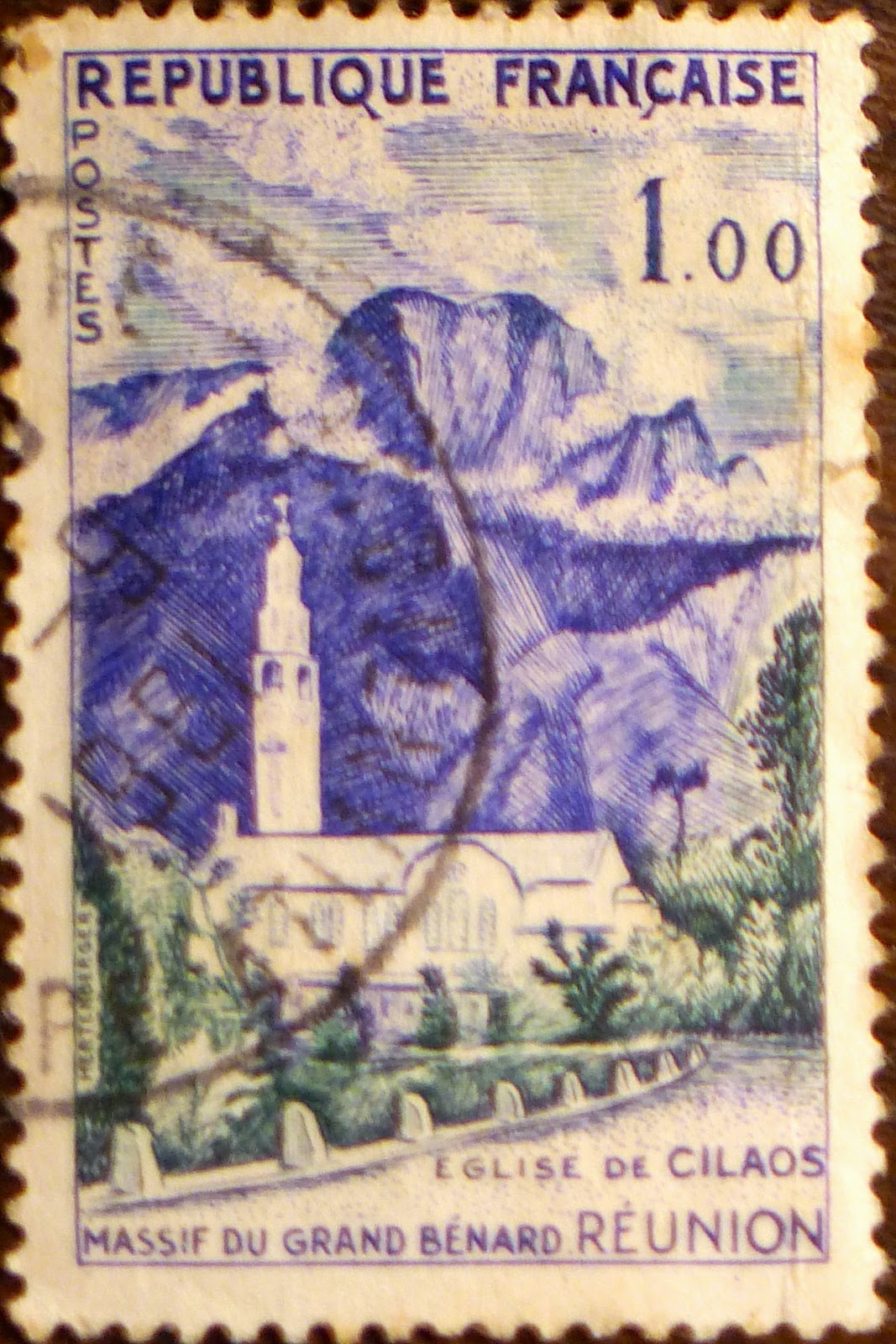
The stamp below was sold on Reunion between January 16th 1960 and May 19th 1962 and was used for sending airmail to Indochina. It has a 1 CFA franc face value and shows the church of Cilaos with the Grand Bénare behind, (although 'Grand Benard' is actually what is printed on the stamp). Bénare means 'very cold place'  in Malagasy.

1960 Cilaos and Grand Bénare stamp

Below is a stamp showing Captain Etienne Regnault and his ship Le Taureau arriving in the Bay of St Paul. It was printed to commemorate the 300th anniversary  of Reunion's permanent settlement.  It was sold between 3rd October 1965 and 18th June 1966 and was used for sending letters in Reunion.

1965 stamp to commemorates the 300th
anniversary of Reunion's permanent settlement

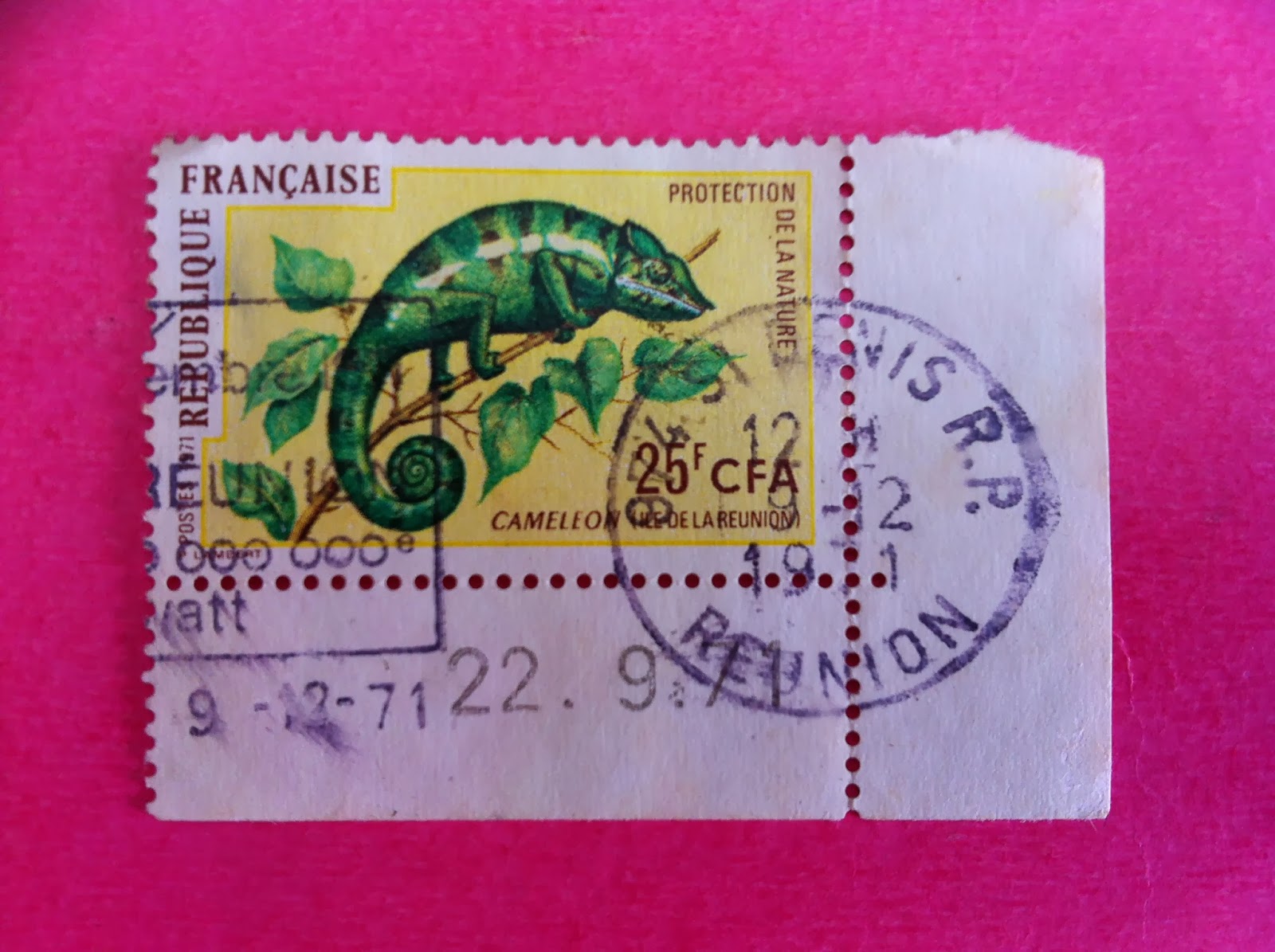
This is a more recent stamp - it was on sale between 8th November 1971 and 7th July 1972. It was used for sending postcards abroad and shows a chameleon.


In 1975 Reunion stopped printing its own stamps, so any Reunion-related stamps since that date (like the two below) are part of French stamp series.

This Barau's Petrel stamp was on sale from 30th April 2007 until 12th December 2008, and was part of a series of French stamps commemorating protected species from overseas France. It is one of the most recently discovered species of seabird as it was only described in 1964, although it was known to locals prior to that.With the exception of a single nest found on the island of Rodrigues the bulk of the population is thought to nest on Réunion. Their colonies are unusual in being far inland and at high elevations; they dig burrows under the forest at around 2400-2700m above sea level. Barau's petrel is considered to be an endangered species. 

2007 Barau's Petrel stamp

The stamp below went on sale in October 2009 to commemorate the centenary of  Juliette Dodu's death. Born in Reunion, she was a heroine of the Franco-Prussian War of 1870, and was the first woman to be awarded the French Legion of Honour.